



Introduction: AI Scales Rapidly, Yet Voice Input Constantly Fails
Enterprises are rolling out AI agents and automated workflows to reshape daily operations. But most AI deployments underperform due to an overlooked issue:
|
AI underperforms not for lack of intelligence, but unreliable input signals. |
Voice remains the primary channel for human-AI interaction in real workplaces — and the biggest unaddressed bottleneck for AI.
Voice: The Core Interface of the AI Era
Every computing era is defined by its native interface:
• Keyboard → PC Era
• Touchscreen → Mobile Era
• Voice → AI Workforce Era
The standard AI workflow is straightforward:
Human Intent → Voice Capture → AI Agent → Execution
Voice is far more than a communication tool. It acts as the core input layer for all intelligent systems.
The Real Bottleneck: Chaotic Voice Input in Real-World Scenarios
AI operates flawlessly in quiet test environments, yet real workplaces are filled with interference that ruins input quality:
• Ambient background noise
• Mumbled, fragmented speech
• Overlapping dialogue from multiple speakers
• Low-quality microphone capture
This creates an irreversible breakdown chain:
Poor audio capture → Inaccurate transcription → Misread intent → Erroneous AI actions
Minor voice recognition errors can completely disrupt mission-critical AI workflows.
AI Reacts Strictly to What It Hears — Input Quality Sets AI Limits
Humans can fill in gaps and interpret unclear audio, but AI cannot. It executes commands solely based on the audio it receives.
Weak model capability is rarely the limiting factor for AI today. The real constraint is unstable, unclear voice capture across work environments.
What Is AI Voice Infrastructure?
Voice Infrastructure serves as an intermediate layer between humans and AI systems.
|
Core mission: Transform noisy, unstructured real-world speech into clean, standardized data ready for AI processing. |
Key capabilities:
• Real-time noise suppression
• Professional speech signal enhancement
• Consistent continuous voice capture
• Full retention of conversation context
• Low-latency audio processing optimized for AI
This layer is not built to deliver better listening experience for humans. Its goal is to guarantee integrity of input data fed to AI.
Hardware Is Indispensable for Stable AI Interaction
Software-only optimization cannot eliminate physical audio interference. AI relies on physical endpoints to capture human intent.
Modern AI headsets transcend consumer audio devices to become specialized sensor hardware for AI infrastructure:
• All-day voice capture terminals
• Real-time environmental noise filters
• Dedicated pipelines for human-AI voice input
AI Headsets: Foundational Hardware for the AI Workforce
Traditional headsets are designed only for calls, meetings and media playback, unable to support round-the-clock voice interaction with AI agents.
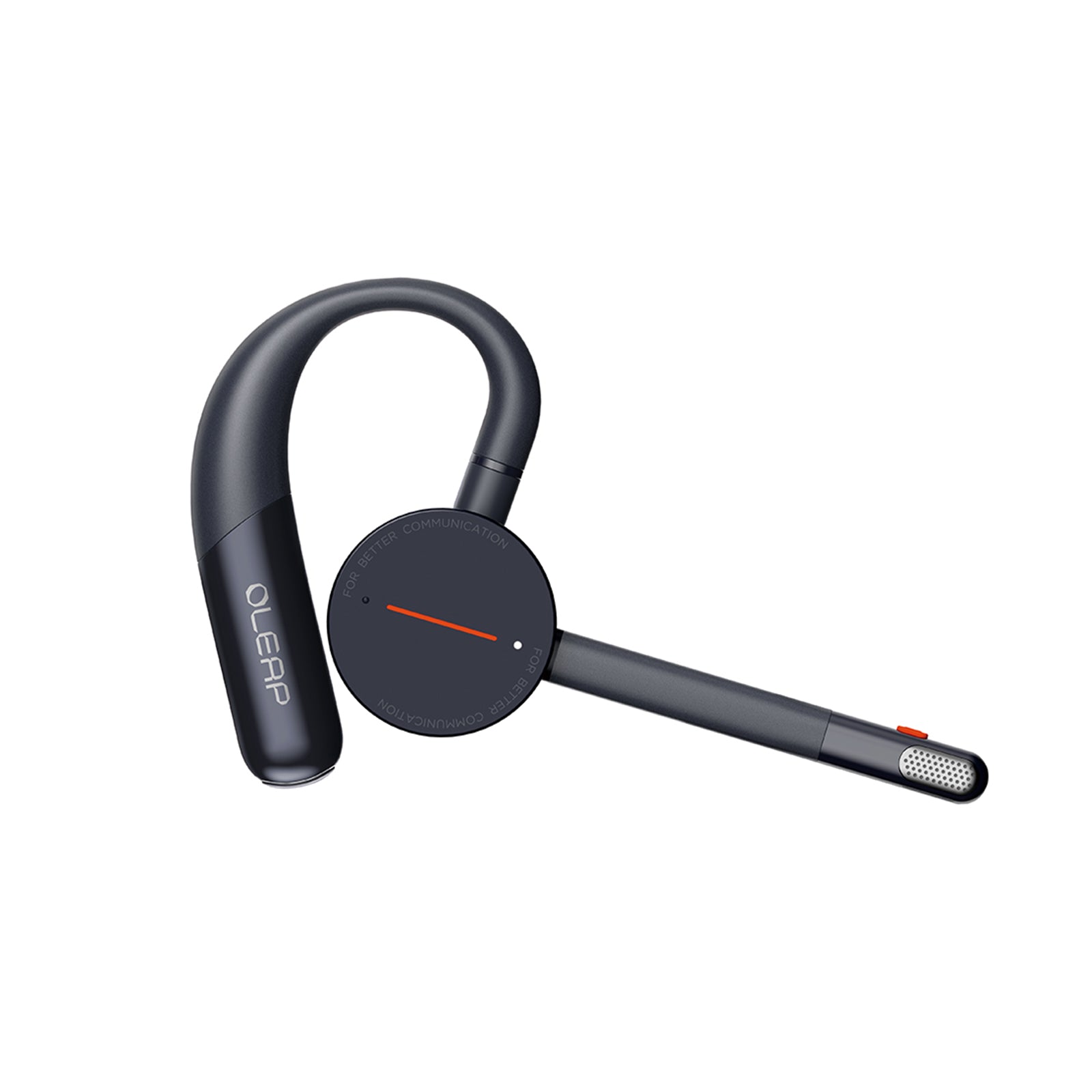
The Oleap Archer features industry-leading 50dB ENC noise cancellation and self-developed noise reduction algorithms, paired with low-latency audio transmission. It blocks background noise, keyboard taps and overlapping voices across all indoor and outdoor environments. With crisp, steady voice capture, you can remotely control AI via voice anytime, anywhere, and keep all AI workflows running reliably in any setting.
The Restructured Full AI Tech Stack
A scalable enterprise AI system consists of five interdependent layers:
1. Foundation Models: Deliver core reasoning and intelligence
2. AI Agents: Automate diverse tasks and workflows
3. Vertical Applications: Generate industry-specific business value
4. Voice Infrastructure: Supply standardized, stable input for AI
5. AI Hardware Terminals: Physical sensors for human voice collection
Productivity Benefits of Robust Voice Infrastructure
Dependable voice input unlocks scalable, practical AI productivity:
• Assign tasks to AI agents instantly via voice
• Capture meetings accurately and generate automatic summaries
• True hands-free multitasking at work
• On-demand AI assistance available all day long
• Less mental effort spent drafting structured prompts
Why Most Enterprise AI Rollouts Fail to Scale
Nearly all software-only AI tools assume clean, well-structured voice input — a condition rarely met in real offices.
The outcome: AI works perfectly in demos but malfunctions amid everyday noise.
|
The root cause is flawed voice input, not weak AI algorithms. |
Industry Shift: From Building AI Tools to Building AI Infrastructure
Enterprise AI development priorities are shifting from standalone AI tools to underlying foundational infrastructure.
Every technological revolution relies on dedicated core infrastructure:
• Internet era: Routers and network infrastructure
• Mobile era: Cellular base station infrastructure
• Cloud era: Servers and data center infrastructure
• AI Workforce era: Voice Infrastructure
Conclusion: AI Must Hear Clearly Before It Can Reason and Act
The next frontier of AI competition is no longer about more powerful foundation models, but stable, reliable human-machine connectivity.
|
Before AI can reason, plan and execute, it must capture human speech accurately. |
Voice Infrastructure fills the missing gap for stable, scalable enterprise AI operations.